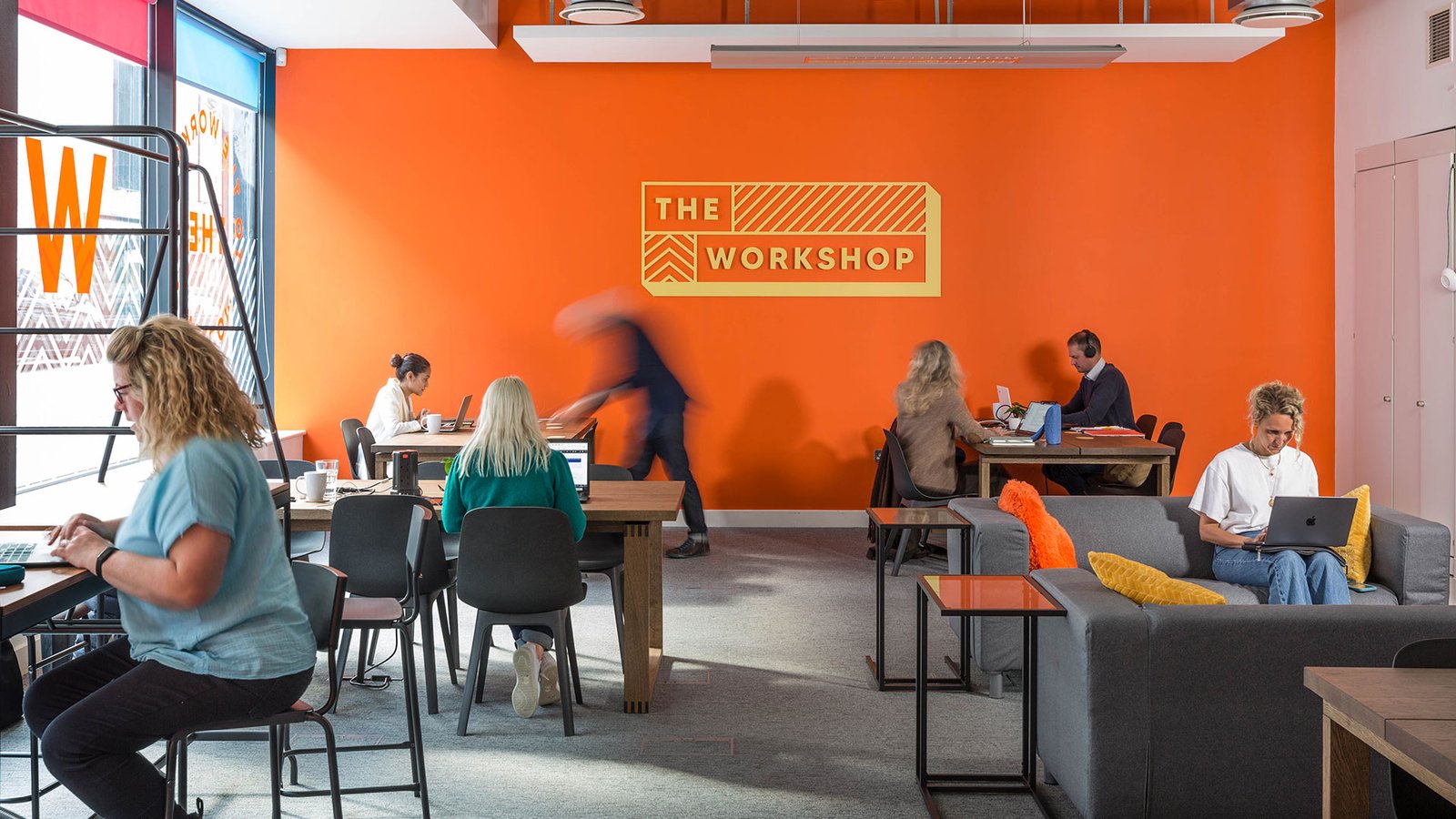
If you've ever noticed that you power through your to-do list in a coffee shop or a shared office but stall at the kitchen table, you're not imagining it. There's a surprising amount of research on why humans work better in the company of others - even when nobody's talking to each other.
Here's what the science actually says, with links to the studies behind it.
1. Just being near other people working makes you work harder
Ever sat down to work in a library or a busy cafe and found yourself weirdly focused? Nobody's watching you, nobody's checking your output, and yet you get on with it. That isn't a personality quirk. It's one of the oldest findings in psychology, and it applies just as much to a shared workspace as it does to a reading room.
This one goes back a long way. In 1898, psychologist Norman Triplett noticed that cyclists rode faster when they had company than when they rode alone, and set up one of the first experiments in social psychology to prove it. The effect has a name - social facilitation - and it's been studied ever since.
The modern version is what the ADHD community calls "body doubling": working alongside someone else, even if they're doing something completely different, to help you start and stick with a task. It's not clinically proven yet, but it's widely used for a reason, and it sits on top of a century of evidence that the presence of others sharpens our focus on the things we already know how to do.
In practice: a shared workspace gives you a room full of body doubles, no arrangement required.
2. Feeling part of a group boosts motivation - even when you're working alone
Here's the part most people miss: it isn't just physical presence that helps. The feeling of being in it together does something on its own, whether or not anyone is actually in the room with you. Freelancers often describe this as the difference between grinding through a job in isolation and knowing that a dozen other people down the corridor are grinding through theirs too.
A Stanford study by Priyanka Carr and Gregory Walton (2014) tested exactly this. People who were given subtle cues that they were "working together" with others - despite sitting alone in a separate room - persisted longer on hard tasks, enjoyed them more, and felt less drained afterwards. They were also more likely to come back to similar work a week or two later.
You don't need to collaborate with anyone to get this. You just need to feel like you're part of something.
3. Working alone is lonelier than you think
Working from home has a lot going for it. No commute, no dress code, your own kettle. But ask anyone who's done it full-time for a few years and a familiar pattern comes up: days blur together, the only conversations are on Teams, and by Thursday you realise you haven't left the house since Monday. The data backs that up.
Gallup's 2024 State of the Global Workplace report found that 25% of fully remote workers felt lonely "a lot of the day", compared with 16% of people working on-site. Buffer's [State of Remote Work](https://buffer.com/resources/insights-2023-state-of-remote-work/) survey found the single biggest struggle for remote workers wasn't loneliness itself but this: "I stay home too often because I don't have a reason to leave" (33%).
That matters beyond how you feel. A landmark meta-analysis of over 300,000 people (Holt-Lunstad, 2010) found that weak social relationships carried a mortality risk comparable to smoking up to 15 cigarettes a day. That's a comparison of effect sizes rather than a literal equivalence - but the direction is clear.
In practice: a workspace is a reason to leave the house. Sometimes that's all it takes.
4. Coworkers "thrive" more than people in regular offices
"Thriving" is a proper term in workplace psychology. It means feeling energised by your work and that you're learning and growing rather than just getting through the week. It's been measured across thousands of employees in traditional offices, so there's a well-established baseline to compare against - which is what makes the coworking numbers stand out.
Researchers from the University of Michigan surveyed hundreds of coworking members and found they reported thriving at nearly 6 on a 7-point scale - at least a point higher than the average for employees in conventional offices (Spreitzer, Bacevice and Garrett, Harvard Business Review, 2015). The researchers were surprised enough that they went back and checked the data.
Their explanation: coworkers have autonomy over how and when they work, see their work as meaningful, and have a community around them without office politics. A follow-up peer-reviewed study (Gerdenitsch et al., 2016) found that the social contact in coworking spaces acts as real social support, linked to higher job satisfaction.
5. Hybrid working is the sweet spot - and coworking is hybrid for the self-employed
The remote-versus-office argument has mostly been settled, and the answer turned out to be "a bit of both". Big employers have landed on two or three days in, the rest at home, because that's what keeps people productive without making them miserable. The interesting question is what that means for everyone who doesn't have an employer's office to go to.
Stanford economist Nicholas Bloom has run the most rigorous experiments on remote work. His 2024 study in Nature (1,612 employees, randomised trial) found that hybrid working - a few days at home, a few days out - cut quit rates by a third with no drop in performance. His earlier 2015 experiment found home working boosted output by 13%, but when staff were later given the choice, over half opted to come back in.
The catch is that hybrid only works if you've got somewhere to go. If you're freelance, self-employed or fully remote, there's no company office to split your week with. A coworking space fills that gap - you keep the flexibility and gain the structure.
In practice: home stays home, work gets its own place, and you get the best of both.
6. Your surroundings change how well your brain works
We tend to think of productivity as something that happens in our heads - discipline, motivation, caffeine. But your brain is running on whatever your surroundings give it: the light coming through the window, the air you're breathing, what's in your eyeline when you look up from the screen. Change those and your output changes with them, whether you notice or not.
The physical space matters more than most of us assume:
-
Plants: field experiments in real UK and Dutch offices found adding plants to a bare office increased productivity by around 15% (Nieuwenhuis et al., 2014).
-
Natural light: office workers with good daylight reported an 84% drop in eyestrain, headaches and blurred vision (Cornell University, 2018).
-
Fresh air: Harvard's COGfx study found cognitive test scores roughly doubled in well-ventilated conditions versus typical office air (Allen et al., 2016).
A well-designed shared workspace pulls all three levers at once. A spare bedroom with the radiator on usually doesn't.
7. But noise is the enemy - so the right space needs quiet corners too
None of this means "more people, always better". Anyone who's tried to write something difficult next to a colleague on a 45-minute call knows that other people can be the biggest distraction in the building, not just the biggest motivator. The research on open-plan offices makes that point rather bluntly.
Here's the counterintuitive bit. When Harvard researchers tracked two large companies moving to open-plan offices, face-to-face interaction dropped by around 70% and email went up (Bernstein and Turban, 2018). Removing the walls made people withdraw, not mingle.
The lesson isn't that shared spaces don't work - it's that good ones offer a mix. Sociable areas for the chat and the coffee, quieter zones for deep work, and somewhere to take a call without becoming everyone else's problem.
In practice: if you're on calls all day, book a booth or a room. Your neighbours will thank you, and the research says you'll get more done too.
The short version
You're wired to work better around other people. It's not about being social for the sake of it - it's about motivation, structure, light, air and having a reason to get out of the house. The evidence has been stacking up for over a century; coworking just makes it easy to act on.
Want to see how it feels? Book a free tour or try a Day Pass at The Workshop Folkestone.
Sources
-
Triplett, N. (1898). The Dynamogenic Factors in Pacemaking and Competition. American Journal of Psychology.
-
Carr, P. B. and Walton, G. M. (2014). Cues of working together fuel intrinsic motivation. Journal of Experimental Social Psychology.
-
Gallup (2024). State of the Global Workplace: 1 in 5 employees worldwide feel lonely.
-
Buffer (2023). State of Remote Work.
-
Holt-Lunstad, J., Smith, T. B. and Layton, J. B. (2010). Social Relationships and Mortality Risk: A Meta-analytic Review. PLoS Medicine.
-
Spreitzer, G., Bacevice, P. and Garrett, L. (2015). Why People Thrive in Coworking Spaces. Harvard Business Review.
-
Gerdenitsch, C. et al. (2016). Coworking Spaces: A Source of Social Support for Independent Professionals. Frontiers in Psychology.
-
Bloom, N., Han, R. and Liang, J. (2024). Hybrid working from home improves retention without damaging performance. Nature.
-
Bloom, N. et al. (2015). Does Working from Home Work? Evidence from a Chinese Experiment. Quarterly Journal of Economics.
-
Nieuwenhuis, M. et al. (2014). The Relative Benefits of Green Versus Lean Office Space. Journal of Experimental Psychology: Applied.
-
Hedge, A. / Cornell University (2018). Daylight and Workplace Study.
-
Allen, J. G. et al. (2016). Associations of Cognitive Function Scores with Carbon Dioxide, Ventilation, and VOC Exposures. Environmental Health Perspectives.
-
Bernstein, E. S. and Turban, S. (2018). The impact of the 'open' workspace on human collaboration. Philosophical Transactions of the Royal Society B.